From Feasibility to Commissioning: Inside a Submarine Cable Project
6/11/26, 1:00 pm
A submarine cable project does not begin when a cable ship leaves port.
By that point, years of decisions may already have been made.
The markets to connect. The capacity the system needs to support. Where the cable should land. Which route it should take across the seabed. How it will avoid known hazards. What equipment will be required. Which permits must be secured. How marine, terrestrial and terminal infrastructure will eventually come together as a single operational network.
The cable itself may be the most visible part of the project, but delivering international connectivity is really an exercise in coordinating hundreds of decisions across engineering, manufacturing, marine operations, logistics, regulation and project management.
And many of those decisions are made long before anything reaches the ocean.
The project starts with a problem, not a cable
Every submarine network begins with a reason for existing.
It might be the need for additional international capacity between growing markets. A requirement for greater route diversity. The expansion of cloud and data centre infrastructure. A national resilience objective. Or the need to connect an island or geographically isolated community more effectively with the wider digital economy.
Those objectives shape almost everything that follows.
Early feasibility work considers the commercial and technical requirements of the network, potential landing locations, capacity expectations, resilience objectives and possible routes.
This is where the broad ambition of a project begins to encounter geography.
A route that appears straightforward on a map may look very different once water depth, seabed conditions, existing infrastructure, shipping activity, environmental considerations and landing requirements are taken into account.
The purpose of this early stage is not simply to find a line between two locations. It is to determine whether a network can be built in a way that is technically achievable, commercially informed and capable of supporting its intended role over the long term.
Designing a system for the real world
Once the opportunity has been defined, the network has to be engineered.
A submarine cable system is considerably more than fibre on the ocean floor.
Depending on the project, it may incorporate submarine cable, optical repeaters, branching units, power feeding equipment, submarine line terminal equipment, landing infrastructure, terrestrial connections and network management systems.
The architecture has to consider how all of those elements work together.
Route length and depth influence cable configuration. Capacity requirements affect optical design. Multiple landing locations may require branching architectures. Shore conditions can influence protection and installation requirements. Long-term growth expectations need to be considered alongside the capacity required when the system first enters service.
Those decisions matter because submarine infrastructure operates on a very different lifecycle from most of the digital technologies it supports.
Applications can change quickly. Cloud environments can evolve continuously. A submarine network may remain in service for decades.
Design therefore has to look beyond the immediate requirement and consider how the infrastructure can continue supporting demand as technology and patterns of international data movement change.
Before installation comes preparation
Once a route has been proposed, it needs to be understood in much greater detail.
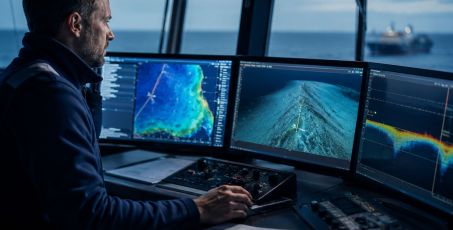
Marine surveys assess seabed conditions, potential hazards and installation requirements along the proposed path. Shore-end planning considers how the cable approaches land and connects with terrestrial infrastructure. Burial requirements and cable protection strategies need to reflect the environment through which the system will pass.
At the same time, regulatory and environmental requirements have to be addressed.
A multi-country cable system can involve different permitting regimes, landing requirements and stakeholder expectations in every jurisdiction it reaches.
This is one of the less visible complexities of international infrastructure.
A network may be global in design, but it has to be delivered locally at every landing point.
Careful preparation cannot remove every uncertainty from a major marine project. It can, however, reduce avoidable risk and make installation considerably more predictable.
Manufacturing is part of a much larger choreography
While survey and permitting activities progress, the physical system itself has to be produced.
Cable, repeaters, branching units, power equipment and terminal systems must be manufactured, integrated and tested against the requirements of the network.
That creates another layer of coordination.
Production schedules must align with marine readiness. Long-lead components have to be managed. Factory and system testing need to occur before equipment is released for deployment. Cable storage, loading and logistics must be coordinated with the availability of specialist vessels and installation resources.
A delay in one workstream can affect several others.
This is why submarine cable delivery is less like buying a piece of technology and more like managing a major infrastructure program.
Engineering, manufacturing, logistics, marine operations and customer decisions all need to remain aligned as the project moves forward.
When the ocean becomes the worksite
Cable installation is the stage most people associate with submarine networks.
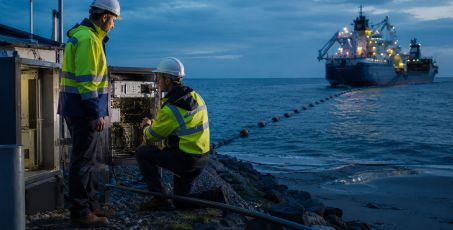
Specialist vessels load the cable system and deploy it along the engineered route. Shore ends are installed. Where required, the cable is buried or otherwise protected. Terrestrial works connect the submarine infrastructure with landing stations and onward networks.
But even here, cable laying is only one part of the job.
Marine, terrestrial and terminal workstreams have to meet at the right places and at the right times.
Weather can affect operations. Vessel availability matters. Seabed conditions may require different installation approaches along different sections of a route. Landing activities need to coordinate with infrastructure and stakeholders onshore.
For complex systems connecting several countries, those interfaces multiply quickly.
Successful installation therefore depends not only on specialist marine capability, but on disciplined project coordination across the complete system.
Laying the cable is not the finish line
Once the physical installation is complete, the network still needs to demonstrate that it performs as intended.
Testing takes place throughout the project, from individual components and factory testing through to complete system validation.
Following installation, end-to-end performance can be assessed against the agreed technical requirements. Acceptance processes are completed. Documentation is finalised. Operational knowledge and support arrangements are transferred to the customer.
Only then is the system prepared to enter service.
This distinction matters.
A submarine cable is physical infrastructure. A commissioned submarine network is an operational system.
Getting from one to the other requires confidence that the many individual components, interfaces and connections perform together as designed.
The infrastructure behind the infrastructure
Perhaps the least visible part of a submarine cable project is the governance that holds everything together.
Major programs can involve customers, consortium members, technology suppliers, manufacturers, marine survey providers, cable ship operators, terrestrial contractors, regulators and specialist partners across several jurisdictions.
Someone has to coordinate the interfaces between them.
Schedules need to be managed. Design decisions reviewed. Changes controlled. Risks escalated. Customer and consortium stakeholders kept informed. Manufacturing, vessel, permitting and installation dependencies understood before they become problems.
In that sense, project governance is itself part of the infrastructure.
It provides the framework through which many highly specialised activities can eventually become one functioning network.
From an idea on a map to infrastructure beneath the ocean
Submarine cable systems are often represented by simple lines connecting points on a map.
The reality behind those lines is considerably more complex.
Each represents years of planning, engineering, manufacturing, survey work, regulatory coordination, logistics, marine installation, terrestrial integration, testing and commissioning.
NEC has worked in submarine cable systems for more than six decades, combining engineering, technology, manufacturing and project delivery capability across transoceanic, regional, island and multi-country infrastructure programs.
For customers in Australia, New Zealand and the wider Pacific, NEC Australia provides a local pathway into that global capability, helping connect regional requirements with the specialist expertise needed to develop and deliver international infrastructure.
The cable may ultimately disappear beneath the ocean. The work required to put it there is anything but simple.