One operating loop: Why control rooms, drivers and passenger information must work as one system
19/11/26, 3:00 pm
In a transport network, the control room, drivers and passenger information systems all need to work from the same picture. The control room coordinates the network. Drivers deliver the service on the road. Passenger information systems tell people what is happening. When these functions are connected, operators can manage services more effectively and passengers receive clearer, more accurate information.
However, too often, these functions operate in parallel. The control room sees one version of events. Drivers experience another. Passengers are told something else again. The result is more than a communication gap. It affects how the service is managed in real time.
Most operators already have access to significant volumes of operational data. The challenge is ensuring that information reaches the right people, informs decisions and is reflected in what happens across the network.
The cost of operating in silos
Disconnected workflows create extra work across the network, from repeated radio calls and manual updates to delays in getting accurate information to passengers.
Consider a disruption that requires a detour. The control room identifies the issue and determines an alternative route. That information may reach drivers through radio or separate systems, sometimes with delays or room for interpretation. Meanwhile, passenger information channels may not update at the same time or may reflect an incomplete version of events.
Drivers may receive different instructions. Passengers are left with unclear or conflicting information. Control teams spend valuable time answering follow-up queries and resolving misunderstandings instead of focusing on managing the disruption.
The consequences extend beyond the immediate incident. Delays in recognising issues, repeated communication and manual workarounds add pressure to already busy operations teams.
The passenger impact is equally important. A control room might know a detour is in place, while passengers continue waiting at a stop that is no longer being served. Even when the operational response is underway, the passenger experience suffers if information has not caught up.
The problem is not simply the disruption itself, but the time it takes for decisions and information to move through the network.
Introducing the operating loop
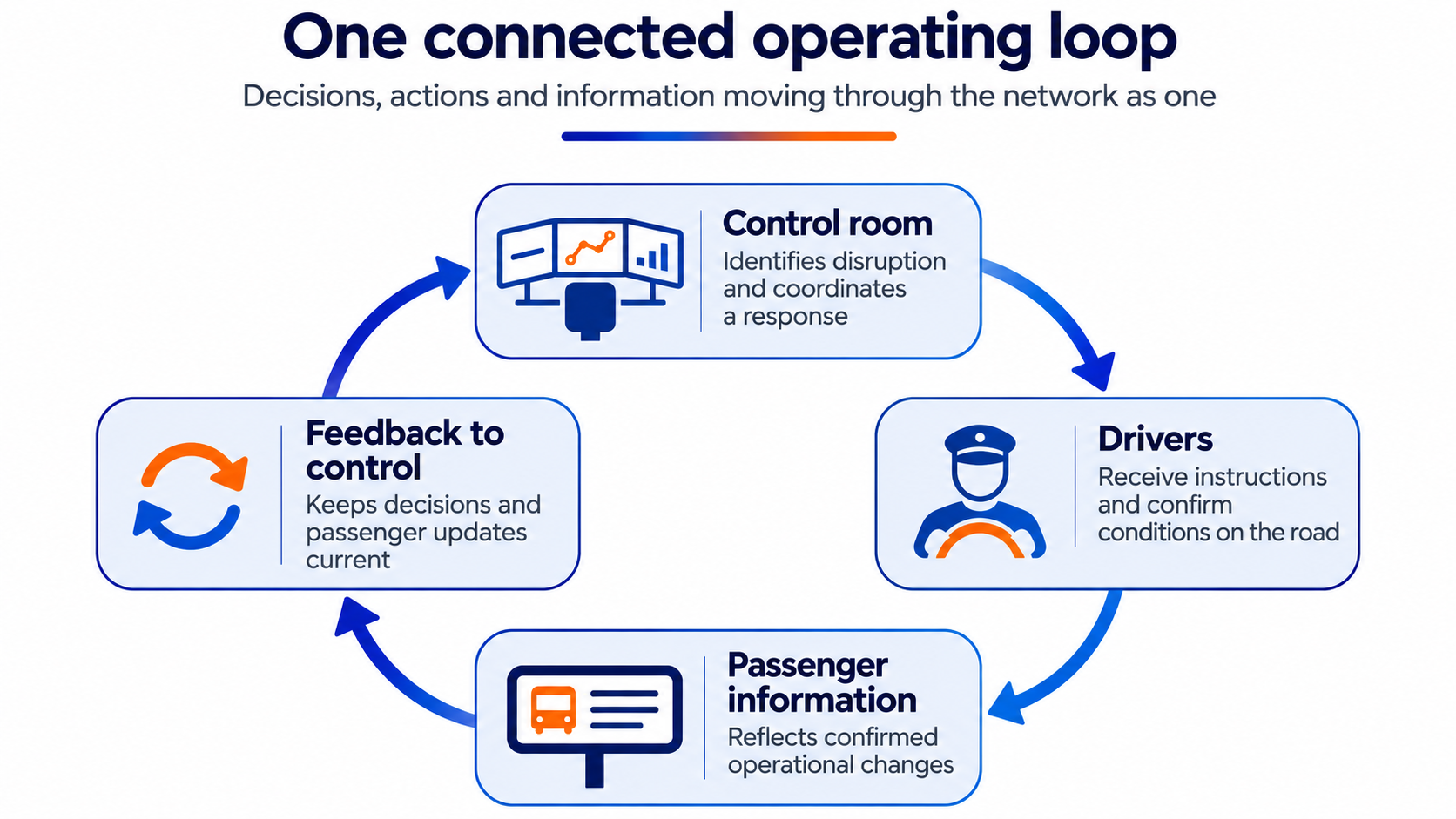
Rather than treating control, drivers and passenger information as separate functions, operators need to connect them through a continuous operating loop.
The principle is straightforward: operational decisions should reach the people responsible for carrying them out, while information from the field should feed back into control and keep passenger communications accurate.
Consider how this could work during a service disruption:
1. Control room: Identify and coordinate
The control room identifies a disruption, assesses its impact and determines the appropriate response, such as a temporary detour or service adjustment.
2. Drivers: Act and provide feedback
Drivers receive clear instructions about the change and confirm what is happening on the road. If conditions differ from what was expected, they can report that information back to control.
3. Passenger information: Communicate the change
Passenger-facing systems reflect the confirmed operational changes, helping people understand how their journeys are affected and what alternatives are available.
4. Feedback: Keep the network informed
As conditions change, information from drivers and the wider network returns to the control room. Decisions can be adjusted and passenger information updated accordingly.
This creates a continuous flow between operational decisions, what happens on the road and what passengers are told.
The operating loop is not simply about connecting technology. It requires workflows that allow information to move between teams without unnecessary delays, duplication or manual intervention.
Why connection matters for reliability
Service reliability depends on more than keeping vehicles on schedule. It also depends on how quickly operators can recognise problems, coordinate a response and restore services when conditions change.
A connected operating loop helps control teams respond with a more complete understanding of what is happening across the network. Information from drivers provides context that may not be visible through monitoring systems alone, while clear operational instructions help ensure that decisions are carried out consistently.
During disruptions, this coordination becomes particularly important. A detour or service adjustment is only effective if drivers understand what they need to do and passengers know how the change affects their journeys.
When operational updates are reflected in passenger information, people can make more informed decisions, whether that means waiting for a delayed service, moving to another stop or choosing an alternative route.
This consistency also supports service recovery. As conditions improve, control teams can coordinate the return to normal operations, with drivers and passenger information systems reflecting the latest decisions.
The result is a network better equipped to maintain service continuity and minimise the impact of disruptions on passengers.
Rethinking operational efficiency
The benefits of a connected operating loop extend beyond reliability. They also change how operational teams spend their time.
Efficiency is often discussed in terms of resource allocation, vehicle utilisation and scheduling. However, a considerable amount of operational effort can be consumed by tasks that arise because information is fragmented.
Repeated radio calls, manual status updates, duplicated reporting and follow-up conversations all require time and attention. During busy periods or disruptions, this additional workload can make it harder for control teams and drivers to focus on their primary responsibilities.
A connected operating model can help reduce these demands.
When instructions are communicated clearly through established workflows, drivers have less need to seek clarification. When information from the field is captured and shared consistently, control teams spend less time reconciling different accounts of the same event. And when passenger updates reflect operational decisions, frontline staff face fewer questions caused by conflicting information.
Structured communication can also reduce unnecessary radio traffic, leaving more capacity for urgent operational matters.
These improvements may seem incremental, but across a large transport network, reducing repeated tasks and manual handoffs can make a meaningful difference to daily operations.
Operational efficiency is not simply about doing more with fewer resources. It is also about removing avoidable work so teams can concentrate on delivering the service.
Beyond technology: A shift in operating model
Technology integration is an important part of connecting transport operations, but it is not enough on its own.
The larger challenge is designing workflows that support coordinated decision-making. Control rooms are increasingly expected to do more than monitor performance and respond to incidents. They need to actively manage the network as conditions change.
That requires clear processes for how decisions are made, communicated, carried out and reviewed.
For example, when a control room approves a service adjustment, there should be a defined process for notifying affected drivers, updating passenger information and confirming that the change has been implemented.
Similarly, feedback from drivers needs to reach the people who can act on it, rather than remaining in separate communication channels or operational records.
This also requires clarity around responsibilities. Teams need to understand who makes a decision, who communicates it, who confirms its implementation and who ensures passenger information remains accurate.
Without these processes, even well-integrated technology can leave gaps between what the control room decides and what happens across the network.
The opportunity is to design operations around the complete journey of information, from the initial issue through to the response and recovery.
A more responsive way to operate
Transport networks are defined not only by how well they run under normal conditions, but by how effectively they respond when things change.
Reliable services depend on operational decisions reaching the right people at the right time, supported by accurate information from the field and consistent communication with passengers.
The goal is clarity, not complexity.
Operators do not need more disconnected inputs. They need decisions, actions and information to move through the network as one.
When control rooms, drivers and passenger information work within a connected operating loop, reliability becomes something operators can actively manage, rather than simply measure after the fact.